When Chaos Feels Familiar: Reflections on Regulation, Meaning, and Music
Through both personal experience and my work as a therapist, I’ve come to see that distress is often meaningful. It tells us something about our needs, our limits, and the environments we’re moving through. When those needs go unmet for long enough, the body finds ways to signal.
Experiencing Baseline Chaos
There are times when chaos doesn’t feel like a moment in life, but a baseline. A steady sense of overwhelm, restlessness, or disconnection that can be difficult to name, even internally.
Many neurodivergent adults describe this experience as a feeling of being out of sync — with expectations, with environments, or with themselves. It’s not always dramatic, but it can be deeply tiring.
Understanding Chaos Through the Nervous System
Earlier in my life, I did not yet have language for this. What I understand now is that what felt like “chaos” was also a nervous system responding to sustained pressure and misattunement. Not a failure — but an attempt to cope.

Through both personal experience and my work as a therapist, I’ve come to see that distress is often meaningful. It tells us something about our needs, our limits, and the environments we’re moving through. When those needs go unmet for long enough, the body finds ways to signal.
Finding Regulation Through Music
Music became one of the ways I learned to listen to those signals. Not as a solution, and not in a performative sense, but as a regulating experience.
Rhythm, repetition, and sound can offer containment when words feel inaccessible. This isn’t unique — humans are wired for rhythm and attunement long before language develops.
Music and Creativity in Counselling
In counselling, music and creativity can offer a gentle bridge. They can:
Support regulation
Allow emotions to move
Create space for awareness without pressure to analyse or fix
Importantly, this work is always led by the individual — at their pace and with consent.
You Are Not Broken
If you’re reading this and feel chaotic or overwhelmed, I want you to know that you are not broken. Healing is rarely linear, and it often happens through small, manageable shifts, rather than sudden change.

Small Steps That Can Help
Some gentle ways to begin:
Notice what helps you feel even slightly more settled.
Share a small part of your experience, without needing to explain everything.
Move at your pace, listening to your nervous system.
Seek support that feels respectful and collaborative.
Meeting Yourself With Curiosity
You don’t need to have all the answers and you don’t need to make sense of everything right now. What matters is meeting yourself with curiosity rather than judgement. If you feel almost ready to explore this further, I’ll wait to hear from you.
Neurodivergent Burnout + Sensory Soothing Toolkit
This article explores causes, symptoms and strategies for managing and recovering from neurodivergent burnout offering tips and insights for recovery. Downloadable worksheet inside.
Burnout is often associated with chronic work-related stress, leading to exhaustion and reduced efficacy. For neurodivergent individuals, such as those with conditions like Autism Spectrum Condition (ASC), Attention Deficit and Hyperactivity Disorder (ADHD), dyslexia, and other neurological differences, burnout takes on a more distinct and profound form.
To manage neurodivergent mental wellbeing and energy levels, it is important to understand the nuances of neurodivergent burnout. This article explores causes, symptoms and strategies for managing and recovering from neurodivergent burnout, offering insights and tips for neurodivergent individuals in understanding and navigating their own experiences.
What is neurodivergent burnout?
Neurodivergent burnout is a state of intense mental, emotional and physical exhaustion from the increasing toll of navigating a world that isn’t designed for you. It's not ‘just’ fatigue but a deep depletion that can lead to a temporary loss of skills, increased sensory sensitivities and significant changes in behaviour. It can feel like your internal resources are completely drained, leaving you with nothing left to give.
To understand neurodivergent burnout, it is important to note that neurodivergent individuals already operate on lower ‘spoons’ resulting in reduced energy levels compared to their counterparts. Therefore, without the necessary support, individuals are more likely to exhibit a significant co-morbidity rate for additional mental health conditions.
Why does neurodivergent burnout occur?
Neurodivergent individuals spend amounts of energy daily to navigate social expectations, process sensory information, and manage executive functions in environments that are not accommodating their needs (as in the case of lower ‘spoons’). This may include information processing, shifting and directing attention from one task to the other, cognitive flexibility, procrastination, organisation, and prioritisation. This constant mental effort often involves ‘masking’, meaning hiding of neurodivergent traits in the pursuit of fitting in. This is a main cause of burnout which often leaves individuals navigating the world outside of their Window of Tolerance.
Window of Tolerance
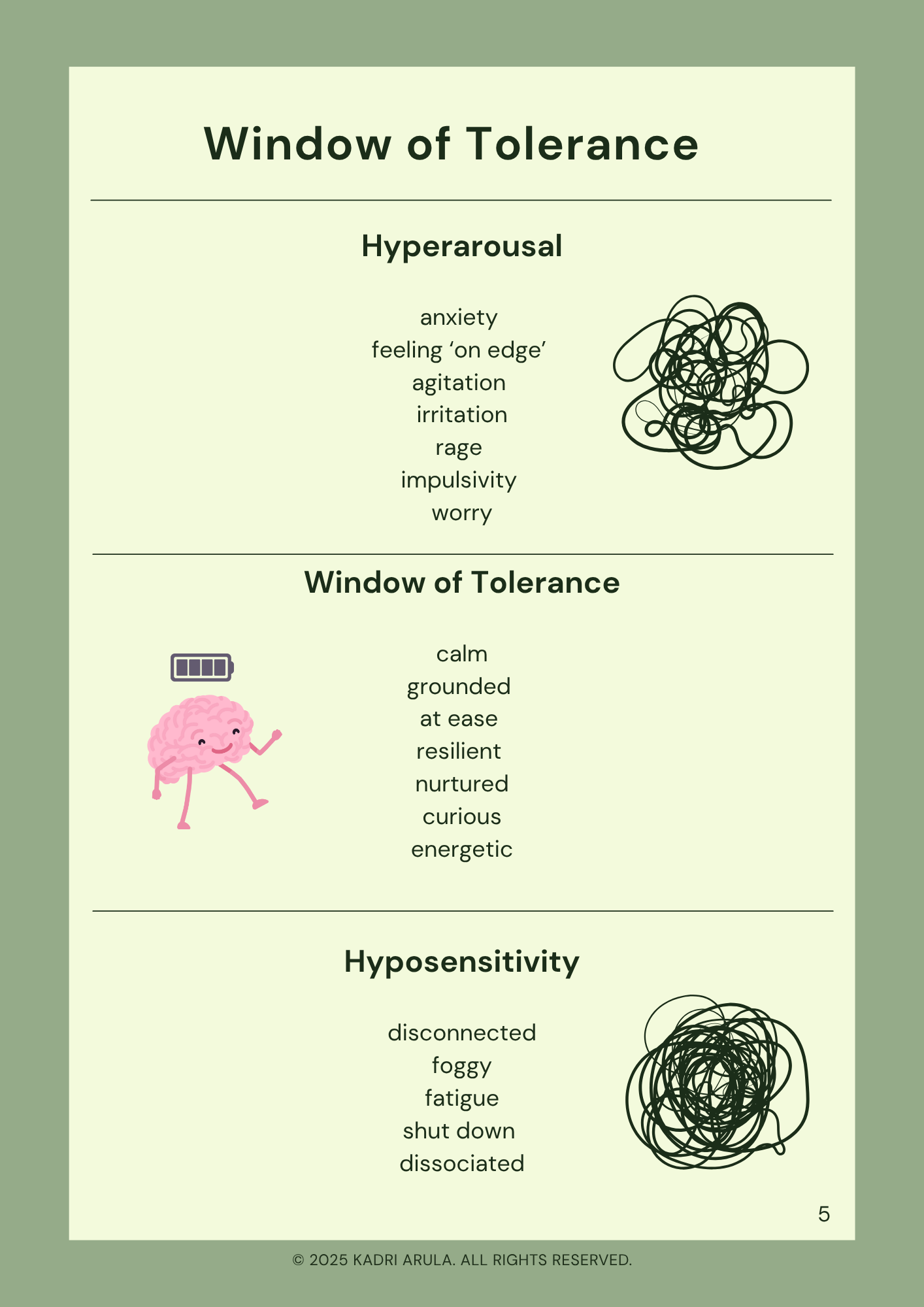
The Window of Tolerance, originally coined by Dr. Daniel Siegel (1999), refers to the optimal zone of arousal in which an individual can function most effectively. Within this 'window,' a person can manage their emotions, thoughts and physiological responses by remaining regulated and adaptable. When someone is within their Window of Tolerance, they can effectively process information, respond thoughtfully and engage in social interactions without becoming overwhelmed or shutting down.
While a neurotypical person's Window of Tolerance can fluctuate, it generally allows for a wide range of experiences. However, for many neurodivergent individuals, their Window of Tolerance may be inherently narrower, or more easily breached, due to sensory processing needs.
Sensory processing
Many neurodivergent individuals experience heightened sensitivity (hypersensitivity) or lowered sensitivity (hyposensitivity) to various stimuli across different sensory modalities (Tomchek and Dunn, 2007). This constant exposure to overwhelming sensory input can quickly push an individual out of their window into a state of hyperarousal (fight/flight/freeze) or hypoarousal (shutdown/dissociation). This can manifest in:
Auditory sensitivities (e.g. public transport, busy office, distant sounds).
Visual sensitivities (e.g. bright or flickering lights, certain patterns, visual clutter, or direct sunlight).
Tactile sensitivities (e.g. clothing tags, rough fabrics, light touch, specific temperatures).
Olfactory (smell) sensitivities (e.g. triggers to certain smells such as strong perfumes, cleaning products, food odors, environmental smells).
Gustatory (taste) sensitivities (e.g. reactions to certain tastes or textures of food, leading to limited diets or the need for specific foods).
Proprioception (body awareness) (e.g. feeling clumsy, difficulty with motor planning,need for deep pressure).
Vestibular processing (movement, balance) (e.g. discomfort with motion, dizziness, or a strong need for spinning/rocking).
These responses may vary according to the individuals’ emotional state, surrounding environment and overall wellbeing.
When neurodivergent individuals are repeatedly pushed outside their Window of Tolerance (either into states of hyperarousal such as anxiety, meltdowns, agitation, or hypoarousal such as shutdown, dissociation, extreme fatigue) the nervous system can become chronically dysregulated. The sustained state of dysregulation significantly contributes to the profound exhaustion and depletion that is characteristic of neurodivergent burnout.
Creating your sensory soothing toolkit
Navigating neurodivergent burnout is not easy. Yet with heightened awareness, empathic understanding and with neuro-affirming strategies, recovery and long-term prevention is possible. It is about understanding and validating your own sensory needs and experiences.
In this toolkit below, I have added further information and practical tools to help you get started on sensory experiences. It is about creating a system that accommodates and accepts your needs, not a system that seeks to ‘fix’.
Conclusion
Neurodivergent burnout is tough. However, by understanding and creating awareness of your specific sensory sensitivities it is possible to have stability. By starting to create this awareness for yourself or for your loved one, validating these profound experiences can already be a start of your sensory soothing journey to navigate world with more ease, create resilience and increase mental wellbeing.
Feeling overwhelmed or experiencing neurodivergent burnout? You’re not alone. Arula Counselling offers compassionate, neuro-affirming counrselling to help you understand your individual needs.

References
Arnold, G. L., and Ryan, S. R. (2024). The nuances of neurodivergent burnout: A scoping review. In ASSETS '24: The 26th International ACM SIGACCESS Conference on Computers and Accessibility (pp. 1–13). Association for Computing Machinery. https://doi.org/10.1145/3729176.3729193
Siegel, D. J. (1999). The developing mind: Toward a neurobiology of interpersonal experience. Guilford Press.
Tomchek, S. D., and Dunn, W. (2007). Sensory processing in children with and without autism: a comparative study using the short sensory profile. The American journal of occupational therapy : official publication of the American Occupational Therapy Association, 61(2), 190–200. https://doi.org/10.5014/ajot.61.2.190
7 Things to Know About Me as Your Counsellor
Read more on how I show up in sessions as a therapist, and what to expect when working together with me. I hope it resonates with you 🧡
1. A shared journey
I work collaboratively with my clients, believing we are co-travellers on your journey. You are the expert on your life and I strive to understand your experiences from your perspective with deep empathy. You deserve to have full autonomy in your counselling, and how you’d like these to be structured. I bring in my own experiences, perspectives, and insights to the counselling process, primarily practicing from these three approaches:
Psychodynamic counselling
Using a psychodynamic approach helps to get deeper into why some things may feel familiar to you, and work towards bringing these unconscious patterns to consciousness. This approach is less focused on the ‘problem’ and rather being curious about your ways of relating.

Feminist counselling
I practice from a feminist framework, working within a sociopolitical context. In sessions, I prioritise your voice and support you in creating awareness of how social and cultural contexts are contributing to our therapeutic relationship and the external circumstances of your life. I create a pathway towards healing and empowerment within a socially conscious counselling environment.
Creative arts therapy
Creative arts therapy recognises that not all emotions can be expressed verbally. This approach is focused on the connection of the mind and body and the felt sense of your experiences. It promotes self-awareness, self-expression, and personal growth. It is a process-focused approach where no previous musical or artistic skills are necessary.
2. Less about finding ‘solutions’ or ‘fixing’
You are not ‘broken’ and need to be ‘fixed’! Your emotions are a natural part of the human experience, even the painful ones. Our society today tends to be pathologising ‘mental health conditions’ that are focused on treating ‘symptoms’ rather than working out the root of the pain and suffering. Digging deeper and finding out insights about yourself can feel SO empowering!
3. Play as an integral part of connection
Play allows us to interact with others and ourselves in a more spontaneous, authentic, and less guarded way. It often involves the suspension of rigid social rules and expectations, giving way to deeper connections beyond language and cultural differences. Incorporating play allows more room for empathy, shared experiences, self-expression, and emotional regulation.
4. The counselling relationship in itself can be healing
Counselling can offer opportunities for corrective emotional experiences, where you can start to explore and experience healthy and supportive relationships that you may have been lacking in your past. This can help to heal old wounds and create new, healthier patterns of relating, which can be SO helpful towards creating a life for yourself that you deserve!
5. I care deeply for my clients
I care deeply about the well-being of my clients and feel a true desire to show up for you in a way that you need. If there is something I think you could benefit from, I always share these resources with you. I consider myself to be a warm, empathic, and genuine person and that’s how I aim to show up in sessions!
6. Bringing my personality to sessions
I don’t believe in ‘blank slates’ and I have found this unhelpful in my own therapy too. I am a human with so many things I have yet to figure out! My wish is to bring the same humanness to sessions by showing my personality, humour, and directness with compassion and sensitivity. I recognise that I too have my limitations, and I am always ready to admit when I don’t know something. I remain curious to work together towards an answer you need.
7. Living in a way that works for you!
Counselling can be so helpful in figuring out what it is that YOU need. In our daily lives, we can be so overstimulated by other people’s assumptions, opinions and observations. Counselling offers a quiet space from where you can turn towards your inner voice and find out what it has been telling you all along. It’s okay not to have the answers but it may be time to start listening to it, and creating a life that truly resonates with you.
I aim to keep advocating for counselling as I know how much value it has brought to me. My wish is to carry on sharing that with others. If this is something you are willing to give a go, then I look forward to connecting 🧡
How Can Incorporating Creativity Into Your Life Improve Your Mental Health?
In this post, I'll break down the meaning of creativity, its benefits, and how you can start being more creative in your everyday life without overwhelming yourself.

Many of us ignore creativity, like it's a task to be done or that it doesn't have any value if you're not good at it. We play as kids without thinking twice about it. It is what drives us and how we experience the world. Why do we keep losing it when we become adults? In this post, I'll break down the meaning of creativity, its benefits, and how you can start being more creative in your everyday life without overwhelming yourself. By being creative, you can improve your well-being and feelings of fulfilment.
What is creativity?
Creativity refers to the ability to open our minds and be open to change. It allows us to problem-solve, find new perspectives and ideas, communicate with others and help to see how we see ourselves. There is lots of information in that! As a society though, we have lost touch with creativity, where being more precise and fitting in with others has become the norm. That however, doesn't allow our minds to develop in new and innovative ways. Although some of us may be more naturally inclined towards creativity, it is also a skill that can be developed and nurtured over time through practice, training, and exposure to diverse experiences and perspectives.
Benefits of being creative
Creativity helps us to feel more alive and at ease with ourselves, letting us be exactly the way we want to. Some of the key advantages include:
1. Increased problem-solving ability
Creativity helps us to approach problems in unique and unconventional ways, leading to more effective and efficient solutions.
2. Enhanced mental health and well-being
Engaging in creative activities can be a powerful way to reduce stress, improve mood, and promote a sense of purpose and empowerment.
3. Improved communication skills
Creativity supports communicating your ideas and concepts from a new perspective. This in turn will help to express these ideas in new ways in your everyday communication and social skills.
4. Increased innovation and adaptability
Creativity helps us to be more adaptable to change and open to new ideas and experiences, facilitating innovation and growth in personal and professional contexts.
5. Greater sense of self-awareness and self-expression
Creativity allows us to express ourselves in unique and meaningful ways, which can help to develop a stronger sense of identity and purpose.
How can you start incorporating creativity into your life?
Below are some examples of how to start using creativity in your life. Be mindful, though, not to overwhelm yourself with all of them at once. Pick one to begin with and see how it feels. Start doing that once or a couple of times per week, in a way that feels good to you.
Journaling
This is probably the most common one, but many aspects of journalling exist. Julia Cameron, the author of ‘The Artist’s Way’ has suggested to start your day with morning pages, handwriting three pages of whatever comes to your mind. The content of this doesn't matter, we just want to get into the habit of doing so and to develop our creative minds.
Picking up an instrument
Start by picking up an instrument you have on hand by playing with different sounds, experimenting, and finding a melody or a beat. If you can't get your hands on an instrument, then don't worry. You can start experimenting with your voice and see how that sounds. Don't worry about the outcome. It is about experimenting with the sound and getting comfortable with it.
Art dates with loved ones
Organising an art date with your friends or family members can give you the motivation you need. Preparing art materials and taking time to sit with art-making and creating something. You may have a prompt ready where each of you will create a landscape by thinking about what is important to them. Or by drawing a circle in the middle and filling it with shapes or colours that are important to them. There are many possibilities, but connecting through art-making might take the pressure off and offer you a long-awaited quality time.
Writing a poem
You can start by considering a topic you want to write about. It could be a feeling that you've had for a while. Write that down and start mind-mapping lyrics that associate with that word. Don't worry about whether these rhyme or not, you can focus on that later. Enjoy the process of it and see what comes from it.
Movement
Listening to your favourite music and moving to it without any judgement. You can start doing that on your own or with friends, whatever feels comfortable. Notice what is happening in your body. Any tension in certain areas or tightness. Some parts may feel more relaxed than others. Pay attention to it and be curious about the sensations but let them be just as they are without trying to get rid of them.
Small steps towards creativity
Incorporating creativity into your life can be a powerful tool for improving your mental health and well-being. Whether through art, writing, music, or other forms of creative expression, taking the time to nurture your creative side can significantly benefit your mental health. It is a valuable and important trait that can benefit individuals and society as a whole.
If you want to start exploring your creativity with me in a therapeutic space, contact me below. I look forward to hearing from you!
How to Overcome Self-Doubt I 6 Steps to Find Your Confidence
Here is a list of six steps that can support you in overcoming self-doubt and boost your confidence.
Self-doubt may be standing in your way of personal growth and success. It can be holding you back, and I am no stranger to feeling this way. For me, personal therapy has helped hugely in overcoming my fears and doubts about my abilities. Therefore, I have compiled a list of six steps on how to overcome self-doubt that have helped me find self-confidence (which is still an ongoing process of learning with its highs and lows). I hope that these can support you and act as a starting point in the process of overcoming self-doubt, even if just a little bit.
What is self-doubt?
Self-doubt is defined as a lack of confidence in one’s skills and abilities which can lead to feelings of incompetence, worthlessness, and unlovability, as well as difficulties in making decisions. It can further be intertwined with a fear of failure, judgement from others, fear of making mistakes.

This may interfere with your personal or professional relationships, and create a block in pursuing and achieving academic and professional goals. But it doesn’t have to be this way.
How to overcome self-doubt
In this article we’ll cover how to overcome self-doubt and feel more confident in yourself. We’ll cover topics such as developing self-awareness, challenging your negative thoughts, setting manageable goals, finding positive support and taking action. However, it is important to be mindful that this process isn’t easy, so be kind to yourself when going through these. Let’s look at the six steps below.
Step 1: Recognising and acknowledging your self-doubt
Awareness creates opening. Taking the time to reflect on your thoughts and feelings, and being mindful when self-doubt starts to creep in. Acknowledge, that it’s so common to have these thoughts and feelings and that you are not alone in feeling this way, that self-doubt is part of a human experience. By beginning to recognise these feelings, you can start taking back control, managing your thoughts and feelings in a more positive way.
Step 2: Challenge your negative beliefs
Self-doubt stems from negative beliefs about yourself and your abilities. This may be related to your childhood and the false beliefs that others and perhaps yourself have been telling yourself. However, overcoming self-doubt does not mean removing these negative beliefs but rather recognising their presence. Take a pause and start to question whether these thoughts and beliefs are true or not. It is about finding more appropriate ways to support yourself, focusing on our strengths that you may have been looking past, recognising your achievements and reflecting on your achievements.
Step 3: Set realistic goals and celebrate progress
Having goals that are too big may make you feel overwhelmed and like you’re never going to get there (if that’s even possible). Breaking down your goals into smaller, more manageable tasks is an effective way to address self-doubt. You can begin by writing these down and making a visual schedule for yourself. This will help you recognise your capabilities and the progress you’ve made, boosting your confidence and diminishing your self-doubt. Do what works for you and what makes you feel good. Give yourself credit!
Arula Counselling integrates creative, psychodynamic, mindfulness and ACT (Acceptance and Commitment Therapy) approaches with a focus on neurodiversity-affirming and trauma-informed care.
Step 4: Surround yourself with positive influences
Our support network is of huge value on how to overcome self-doubt. To be able to lean onto the people that we trust and feel comfortable with will help you overcome self-doubt and give you strength as you’re moving through these challenges. Engage in conversations with people who believe in your abilities and can provide a strong support system. Furthermore, engaging in activities that make you feel good, whether it’s connecting with your interests, educating yourself on new topics or taking up a new hobby, can all be great ways to boost your confidence and inspire you to reach for your goals.
Step 5: Take action and embrace failure as a learning opportunity
It can be scary to move through your fear. It might be (and probably is) the very last thing you’re interested in doing. However, with appropriate support and encouragement, it is possible. It is about accepting that failure is a natural part of the human experience, and you are not alone in facing it. Acknowledging that stepping through failure helps to build confidence, and act as an opportunity for growth. Mistakes will be a part of that, and that’s okay. Here is an article on resilience.
Step 6: Self-compassion
Most importantly, be kind to yourself through this process of uncovering the thought patterns and ways of being that have been with you for such a long time. Be patient and avoid rushing the process, showing yourself compassion. Allow yourself to experience and acknowledge the emotions that arise, giving them space. This can be either with your loved ones, with people you trust or by finding external support. Finding support is a sign of strength. You deserve to feel good.
How to overcome self-doubt with music therapy?
Music gives a form to our inner feelings that we might be struggling with to express verbally. Bruscia (1989) has indicated that in music therapy, musical experiences are used to restore, maintain and support the wellbeing of the client and to support you in helping to find resources and tools to resolve any difficulties that you may be dealing with and increase your potential for mental wellbeing. Furthermore, Boxill (1985) has expressed that in music therapy, creating musical experiences with the client can help restore, maintain and improve your psychological, mental and physiological health.
Research shows that self-selected relaxation music can significantly reduce anxiety and bring the client into a more relaxed state, lowering the levels of stress and anxiety.
Because music is a means of non-verbal expression, it can create a supportive environment of play where tension is released, reducing stress and giving way to self-expression regardless of one’s skills and abilities.
Music therapy goals are designed to provide emotional support, decrease stress and anxiety, increase self-esteem and self-confidence, and provide a medium for creative self-expression, providing the client with an opportunity for control and independence.
Conclusion
This article has covered six steps on strategies on how to overcome self-doubt and boost confidence. Self-doubt is a common challenge that many people face, but it does not have to define who you are. By following and keeping in mind the steps, it is possible to overcome self-doubt and find peace and confidence in yourself. Throughout your process, remember that it takes courage, commitment and self-compassion to work through your challenges but that there is potential to discover your full potential and achieve success in your life.
If you feel like you’re ready to dive deeper then I look forward to hearing from you.
References
Braslow, M. D. et al. (2012) ‘Self Doubt’ in Social and Personality Psychology Compass 6/6: 470–482, 10.1111/j.1751-9004.2012.0044.
Bruscia, K. E. (1989) ‘Defining Music Therapy’. Philadelphia. PA: Barcelona Publishers.
Cohen, R. L. (1999) ‘The effect of music therapy on the reduction of anxiety for myocardial infarction patients. Unpublished Master’s Thesis, Clarkson College.
Ming, S. WU (2002) ‘Effects of Music Therapy on Anxiety, Depression and Self-Esteem of Undergraduates’. In Psychologia, 45. pp. 104-114.
How to Find the Right Therapist?
How do you know which therapist is right for me? Let's explore some of the things to consider when looking for the right therapist.

I have recently got many questions about how to find the right therapist, from friends to family members to clients. I have had these questions myself and have gone through the process several times. And it’s not easy. I have even felt like I’m online dating when trying to find a therapist - how can I possibly decide? What about the different approaches? Gestalt, integrative psychotherapy, psychoanalysis, counselling, music therapy? What do all these even mean? To help you find a therapist in Berlin, I have put together a list of five things to consider.
Consider your goals for therapy
What are you looking to get from therapy? Are you struggling with a specific situation, looking to improve your well-being, or want to get to know yourself better? Often, we might want to get ‘well’ quick and opt for the short-term option. And it is scary to start therapy. However, finding the right therapist will take time if you are willing to work on yourself. It would be helpful to bring this up with your potential therapist and discuss what might or might not work for you.
Take time to find the right therapist
It is essential to take your time when finding the right therapist. You don’t have to settle for the first one you meet. It may be helpful to prepare some questions to determine whether a therapist is a right fit for you. You may try out a couple of different therapists. Think of them as job interviews where you can decide who you want to work with.
Arula Counselling integrates creative, psychodynamic, mindfulness and ACT (Acceptance and Commitment Therapy) approaches with a focus on neuro-affirming and trauma-informed care.
Feeling comfortable during your therapy session
Feeling comfortable in a session is important. How do you feel when you are with your therapist? Be aware of your feelings. Do you feel a sense of ease? Are you uncomfortable and anxious? Notice what comes up for you, but be aware that feeling uncomfortable is an inevitable part of therapy, and it is normal to feel that way.
Building a connection with your therapist
Building a good connection is an essential part of therapy. If you settle for a therapist you don’t like, the treatment may not be as valuable as it could’ve been. Do you feel safe and listened to? Is it a non-judgmental space where you can be open?
Finding the right type of therapy
Every therapist is different. We all come with different experiences and different ways we relate to clients. We are human after all. A good therapist will be willing to discuss with you if the therapy is not the right fit, and if some other types of therapy may be better for you. You may even discuss whether you would benefit from a different approach. Talk to your therapist about it - they may be able to refer you to someone else and have connections. Be open to discussion. I encourage you to communicate your feelings to your therapist as soon as possible, as it leads to deeper exploration and a better healing journey.
How can therapy help me?
Once you find a therapist that feels right for you, you can start working on creating trust. They will be there for you to hear you out, model healthy boundaries, and encourage talking about topics that you haven’t been able to talk about before. You can start getting to know yourself. The therapist will be the mirror and a reflection of yourself. However, the process will not be easy, and there may be times you don’t want to go to therapy. You may feel like stopping altogether. It takes courage to reach out for support and keep going.
I offer online and in-person counselling and music therapy in English and Estonian in Berlin. I look forward to connecting with you.
How to Start Therapy [If You Have No Idea Where to Start]
Here’s a step-by-step process we’ve put together on how to start therapy – how to set goals for treatment, financial aspects, the referrals and directories to use, and how to meet potential therapists.
Let's face it: finding a therapist isn't always as straightforward as we hope. Navigating the options can feel simply overwhelming.
From struggling to find a therapist that specialises in your specific needs to determine if they accept your insurance, it's a wonder how anyone chooses one.
As a qualified mental health professional, I've worked with clients for over four years now, supporting people with a range of needs, from depression and anxiety to autism and ADHD.

Therefore, I've put together a step-by-step process on how to start therapy – how to set goals for treatment, financial aspects, the referrals and directories to use, and how to meet potential therapists.
Why start therapy?
You know you need therapy. This is already a major step forward toward achieving better mental well-being and quality of life. But how do you start therapy? What is the process, how do you find the right therapist, and what do you talk about in therapy?
Yes, it can all feel like a daunting process, but it is the first step in prioritising your mental health. Whether you're struggling with a specific issue or want to focus on your overall well-being, therapy can offer invaluable support and guidance. It is a place to work on understanding yourself and others, find new ways of communication, improve your relationships and overall well-being.
By the end of this guide, you'll have the tools you need to start your therapeutic journey and help guide you toward achieving better mental well-being and quality of life.
1. Your goals for therapy
You may have some goals for therapy in mind when starting therapy. These may be helpful when thinking about which approach to consider. Perhaps you've noticed:
Higher anxiety levels or tension that is interfering with your daily life;
difficulties in managing your emotions such as anger or sadness;
frequent conflicts in relationships with friends, family, or co-workers;
difficulties concentrating and decreased productivity;
sleep problems, changes in eating habits, or other physical symptoms.
These types of challenges can all be reasons to start therapy. You may be looking for support in navigating a specific situation, wanting to improve your overall well-being, or simply seeking tools and skills to get to know yourself better. Taking the time to clearly define your goals will make it easier to narrow down your search and find a therapist who can best address your unique needs.
2. What type of therapy approach?
If you are looking for short-term therapy to give you tools-based options, Cognitive Behavioural Therapy (CBT) might be a good option for you. If you're looking to understand your patterns and relationship dynamics, a more long-term therapy such as psychodynamic, psychoanalytic, and humanistic approaches may be more appropriate. To get an idea about your specific needs and preferences, take some time to dive deeper into each of these approaches. Moreover, many therapists offer an integrated approach to therapy, which might be the best option for clients. Check the therapist's approach and experience. You can always ask them for more information if anything is unclear. Find more information on different therapy approaches.
3. Insurance or private pay?
When starting therapy, think about whether you could opt for insurance-based therapy or private pay. It is always worth researching whether your health insurance provider covers psychotherapy services. To know more, get in touch with your health insurance provider to ask more about what is covered by them (there's usually more information on your provider's website). They may have some English-speaking options.
When opting for private pay, consider your realistic budget for therapy. How much can you afford to pay? Note that some therapists offer sliding scale fees (cheaper fees for lower-income clients), which you can find out more about by asking whether that's an option for them. Private pay may be a better option if you want to choose your own therapist with whom to work. It can also be a quicker option for care, and you can choose which approach resonates with you the most.
Arula Counselling integrates creative, psychodynamic, mindfulness and ACT (Acceptance and Commitment Therapy) approaches with a focus on neurodiversity-affirming and trauma-informed care.
4. Referrals from people you trust
You may also find it helpful to reach out to people you trust who have been through this process already. Perhaps they have gone through something similar and can recommend you to a specialist who was able to support them. It's useful to talk to your network; you never know the information they may have. However, be mindful that your needs may vary from the people around you, which means that the same therapist may not be suitable for everyone. Although, knowing about other people's processes can support you in your process of starting therapy.
5. Trusted online directories
Diving into the world of online directories can be overwhelming when knowing how to start therapy. Depending on where you live, there are too many specialties, too many, or too few people to choose from. Since the beginning of my career, I have developed great respect towards It's Complicated therapy platform. Through their search filter, you can make choices depending on location, price, need for support, etc. Additionally, you can find recorded videos of therapists talking a bit more about themselves, which is a great way of getting a feel for the therapist. Choosing a couple of therapists from the list may help you to get closer to the one you'd like to work with. Give yourself time to make the best option for you. However, be mindful of some low-cost online counseling services that may not use professional therapists. Check whether the potential therapists are:
Are they registered with a professional body?
Make sure any potential therapist is properly licensed and registered with appropriate professional bodies. This ensures they have the necessary training and qualifications.
What is their experience?
Look for therapists who have experience treating the specific issues you're seeking help with. Their bios should provide details on their background and areas of expertise.
Do they have the information you need on their website?
Can you find the information you needs such as the cost of a session, format of sessions, location etc. If you’re struggling to find it, reach out to them for further details to help you feel at ease before booking the first session.
Take the time to review a few options from trusted online directories. This will help you get a feel for different therapists' styles and specialties so you can make the best choice for your unique needs and preferences.
6. Meeting potential therapists
It can be helpful to prepare some questions before starting therapy to determine whether a therapist is a right fit for you. Meeting a couple of therapists before starting therapy is a common way to go. Think of them as job interviews where you can decide who you want to work with. You could ask questions like:
How long have they been in the profession?
Is it important for you to work with a professional who has been practising for a while, or would you be okay with a trainee therapist who usually offers a lower fee option?
Do they focus on your specific area of concern?
You can scroll through the therapist's website or online directory profile to gather more information on the type of support that you need.
What qualities are you looking for in a therapist?
What are the qualities that are important to you in a therapist such as their background, culture, language, age, gender. This will help you further down your search in finding a therapist who you could …
Timing of the session
Think about when would be the best time for therapy for you. Is it in the morning before starting your workday? Or before the weekend? It is important to allow yourself some time before and after the session to regulate your emotions and ground yourself before jumping into the next thing.
Therapy is a collaborative encounter, where the relationship between the client and the therapist is considered to be the most impactful part of a successful therapeutic experience. Therefore, take your time to make this important decision for yourself.
7. Making a decision
There is power in making the choice for yourself in how to start therapy and which therapist to see, depending on your unique needs and preferences. This is the first step towards healing. After reviewing your options, try to meet with a few therapists. This will hopefully make your decision a little bit easier. By meeting, you can get a better understanding of their personality, communication style, and their therapeutic approach. Pay attention to whether you feel comfortable opening up to them and if you think you could develop a strong, trusting relationship.
It can also be helpful to discuss your thoughts and feelings with trusted friends or family members. However, getting an outside perspective from a trusted professional can provide clarity and reassurance. Trust your gut instinct - if something doesn't feel quite right, allow yourself time to keep searching. By taking an active role in your healing, it can have profound and lasting benefits on your mental and physical well-being.
8. Building a connection with your therapist
Building a good connection is an essential part of therapy. Research shows the importance of alliance, empathy and expectations for therapy being key parts to change. When starting out, I recommend my clients to start with 12 weeks of consistent therapy and then to do a check-in about what works and what doesn't work for you. If after a couple of sessions you feel like it's not working, talk to your therapist about it. They may be able to refer you to someone else or suggest treatment alternatives that work for your specific circumstances. I always encourage you to communicate your thoughts and feelings to your therapist, as it leads to deeper exploration.
Conclusion
The process of starting therapy is not a straightforward one. It is about thinking about your goals for therapy, whether you're willing to put in the work and if you're able to feel supported by your therapist.
Once you find a therapist that feels right for you, you can start working on creating trust. They will be there for you to hear you out, model healthy boundaries, build resilience, and encourage talking about topics that you haven't been able to talk about before. You can start getting to know yourself. The therapist will be the mirror and a reflection of yourself.
However, the process will not be easy, and there may be times you don't want to go to therapy. You may feel like stopping altogether. The decision to start therapy may not come lightly, but it is a huge step toward recovery. Show yourself some kindness in getting this far.
I offer online English and Estonian counselling in Berlin. If you have further questions or would like to go ahead and book a consultation session, I look forward to connecting with you here, or you can email me at arulacounselling@proton.me.
Disclaimer: This content is for educational purposes only. If you are suffering from severe trauma, live in an abusive household or are in danger, call 112 or your country's crisis line, where professional mental health workers can offer you appropriate support. Here are some additional resources.
References
British Association for Counselling and Psychotherapy. (n.d.). Home page. https://www.bacp.co.uk/
Crits-Christoph, P., Rieger, A., Gaines, A., & Gibbons, M. B. C. (2019). Trust and respect in the patient-clinician relationship: preliminary development of a new scale. BMC psychology, 7(1), 91. https://doi.org/10.1186/s40359-019-0347-3
Finsrud, I., Nissen-Lie, H. A., Vrabel, K., Høstmælingen, A., Wampold, B. E., & Ulvenes, P. G. (2022). It's the therapist and the treatment: The structure of common therapeutic relationship factors. Psychotherapy Research, 32(2), 139–150. https://doi.org/10.1080/10503307.2021.1916640
Kottler, J. A. (2017). On Being a Therapist. Oxford University Press. https://www.psychotherapy.org.uk/seeking-therapy/how-to-choose-a-psychotherapist/
Spalter, David (2014) How clients choose their psychotherapist: influences on selecting and staying with a therapist. Other thesis, Middlesex University / Metanoia Institute. https://mirep.metanoia.ac.uk/id/eprint/287/1/DSpalter_thesis.pdf
Wikipedia contributors. (2021, July 1). Common factors theory. In Wikipedia. Retrieved May 13, 2024, from https://en.wikipedia.org/wiki/Common_factors_theory
Hidden Struggles: Exploring the Impact of Autism and Depression in Adult Mental Health
In this blog post, we will explore the unique challenges faced by adults with dual diagnoses of autism and depression and the importance of understanding, support, and music therapy in your journey.

As we delve into the complexities of mental health, it is important that we talk about the hidden struggles that often go unnoticed. Autism and depression are two conditions that can profoundly impact your daily life, especially when experienced together. In this blog post, we will explore the unique challenges faced by adults with dual diagnoses of autism and depression, explore the concept of autistic burnout, and the importance of understanding and support in your journey.
Understanding Autism and Depression
Autism Spectrum Condition (ASC) is a neurodevelopmental condition characterised by difficulties in social interaction, communication, and 'stimming’. Depression, however, is a mood disorder that affects an individual’s overall well-being, causing persistent sadness, loss of interest, and difficulties in managing daily activities. When these conditions coexist, they can create a complex and nuanced mental health landscape.
What is Autistic Burnout?
Depression and autistic burnout are distinct mental health experiences that share common symptoms and challenges. Depression is characterised by sadness and loss of interest, while autistic burnout is specific to those on the spectrum, caused by overwhelming environments and stress. The key difference lies in origins and triggers: depression has varied causes, while autistic burnout is linked to how individuals with autism process information. Recognising these differences is important for effective support and therapy.
The Impact on Mental Health
The impact of autism and depression on mental health cannot be underestimated. Adults with autism often face challenges in social situations, which can lead to feelings of isolation, low self-esteem, and difficulties in relationships. The presence of depression expands these struggles, intensifying feelings of hopelessness and despair. The constant effort to navigate social cues and communication can become overwhelming, contributing to increased vulnerability to mental health issues.
Hidden Struggles and Masking
For adults with autism and depression, the ability to mask your struggles becomes a survival mechanism. You may have developed coping mechanisms to hide your difficulties, masking your true needs, emotions, and internal struggles. This constant masking can be mentally exhausting and takes a toll on an already fragile mental health. It also decreases the likelihood of others recognising your challenges and offering you the necessary support.
The Power of Music Therapy
In the face of these hidden struggles, music therapy emerges as a powerful and effective tool for adults with autism and depression. Music therapy provides a safe and nonjudgmental space where you can express yourself, communicate, and connect with others. Through music, therapists can facilitate emotional expression, reduce anxiety and stress, and support you in developing coping strategies that work for you.
Research has shown that music therapy interventions can improve social interaction skills, enhance self-expression, and boost mood in individuals with autism and depression. Playing instruments, engaging in songwriting, and participating in therapeutic improvisation can foster a sense of empowerment and autonomy. The rhythmic and melodic characteristics of music also stimulate neural networks, enhancing cognitive and emotional processing.
Building a Supportive Community
Creating a supportive community is crucial in addressing the hidden struggles faced by adults with autism and depression. By fostering understanding, empathy, and acceptance, we can break down the barriers that prevent you from seeking help and feeling understood. Educating ourselves about autism and depression, promoting mental health awareness, and creating inclusive spaces are tangible actions that can make a difference.
Conclusion
The intertwining of autism and depression presents unique challenges for adults striving to maintain their mental health. Recognising and addressing these hidden struggles is crucial. Music therapy offers an invaluable avenue for self-expression, emotional release, and personal growth. By embracing the power of music and fostering a support community, we can work together to empower and uplift adults with autism and depression, ensuring you feel seen, heard, and understood in your journey towards mental well-being.
If you’re interested in exploring this further, please contact me here or via the button below. I look forward to hearing from you!
Disclaimer: This content is for educational purposes only. If you are suffering from severe trauma, live in an abusive household or are in danger, call 112 or your country's crisis line, where professional mental health workers can offer you appropriate support.

What’s Your Anger Trying to Tell You?
Recognising the cause of anger and its effects starts with learning about yourself and being curious about where these emotions might be coming from.

I was talking to a colleague a couple of days ago, and the topic of anger came up. The chat led us to dive deeper into the subject of this powerful emotion, discussing how that may manifest in our daily lives and what we can do to start managing it better. Let's explore this further.
What is anger?
Anger is a natural and powerful emotion that we all experience from time to time. It is a response to perceived threats, injustices, or frustrations. However, it can sometimes get in the way of expressing ourselves fully and authentically. Understanding and managing it can improve your mental health, relationships and overall quality of life.
Causes of anger
Being curious about the possible causes of your anger is a starting point in learning about yourself. Recognising where these emotions might be coming from. Here are some of the causes of anger that may lie behind it:
Frustration
When we face obstacles or things don't go as planned, it can lead to feelings of anger.
Injustice
Witnessing or experiencing unfair treatment, discrimination, or violations of our rights can trigger anger.
Threats to self-esteem
Criticism, humiliation, or feeling disrespected can provoke anger.
Fear or pain
Anger can be a defence mechanism when we feel threatened or when we're in physical or emotional pain.
Unmet expectations
When our expectations are not met, whether in relationships, work, or daily life, it can result in anger.
Can you think of a recent situation where these feelings have been coming up? Pay close attention to how that feels in your body and whether there might be an underlying cause of your anger. Be kind to yourself throughout this discovery process, as it may be more difficult than expected.
Effects of anger
Anger can appear in many ways in our daily lives, impacting our overall quality of life. Below, I have listed some of the ways in which anger can affect our lives physically and emotionally.
Physiological responses
Anger triggers the body's "fight-or-flight" response, leading to increased heart rate, blood pressure, and adrenaline release.
Emotional impact
Anger can cause irritability, frustration, resentment, or even rage.
Relationship strain
Uncontrolled anger can damage relationships and lead to poor communication, aggression, or withdrawal.
Health consequences
Chronic anger has been linked to increased stress, cardiovascular problems, weakened immune system, and mental health issues.
Managing and expressing anger
How can you start to manage and express your anger differently?
Recognise your triggers
Identify the situations, events, or thoughts that tend to provoke your anger.
Take a break
If you feel anger escalating, step away from the situation to cool down and gain perspective.
Practice relaxation techniques
Deep breathing, meditation, music listening, art making, or engaging in activities you enjoy can help reduce anger.
Communication
Express your anger assertively, using "I" statements to convey your feelings without attacking or blaming others.
Problem-solving
Instead of dwelling on the anger, focus on finding constructive solutions to the underlying issues.
Seek support
Discussing your anger with a trusted friend, family member, or professional can provide perspective and guidance.
How can counselling support anger?
It's important to note that while anger is a normal emotion, uncontrolled or excessive anger can negatively affect your well-being, relationships, and overall quality of life. If you find it challenging to control your anger or negatively impact your life, seeking support from a counsellor can be beneficial.
Counselling can help you recognise your triggers and what might set you off for showing anger. Learning how to manage these can improve your mental health, your relationships and lead to a better quality of life. So, what is it that your anger is trying to tell you?
If you're ready to explore it further, let's connect over a consultation session here, or email me at arulacounselling@proton.me. I look forward to hearing from you.
Disclaimer: This content is for educational purposes only. If you are suffering from severe trauma, live in an abusive household or are in danger, call 112 or your country's crisis line, where professional mental health workers can offer you appropriate support.
Podcast: Therapy Talk with It's Complicated
Our founder Kadri talks about the possibilities of music therapy, who can benefit from the modality and her journey to becoming a music therapist.
On a dark November evening, Kadri and founder of It’s Complicated and a psychologist Johanne Schwensen recorded a podcast on Music Therapy. They talked about the possibilities of music therapy, who can benefit from it and Kadri’s journey to becoming a music therapist. Have a listen above.
You can find Kadri’s It’s Complicated profile here and her Bandcamp here.
Music written and produced by her.
